







The situation
School administration rarely happens at one desk. Staff deal with admissions, attendance, fees and notices between classes, in the staff room, on the move and sometimes from home. A school management ERP that only works on an office computer leaves most of that work waiting until someone gets back to the right machine.
This school needed its staff to handle admin wherever they were working. It also had a clear limit: it did not want to buy new devices just to make a new system usable.
Those two needs pull in different directions. Access from anywhere usually suggests more equipment, while a fixed budget suggests less. The answer had to come from the software, not from a purchase order.
Why device cost mattered
Hardware is one of the hidden costs of school software. Tablets or dedicated terminals have to be bought, set up, charged, secured and replaced.
For a school, that money competes directly with teaching. A system that only runs on special equipment can cost more to roll out than the software itself.
What we built: a school management ERP
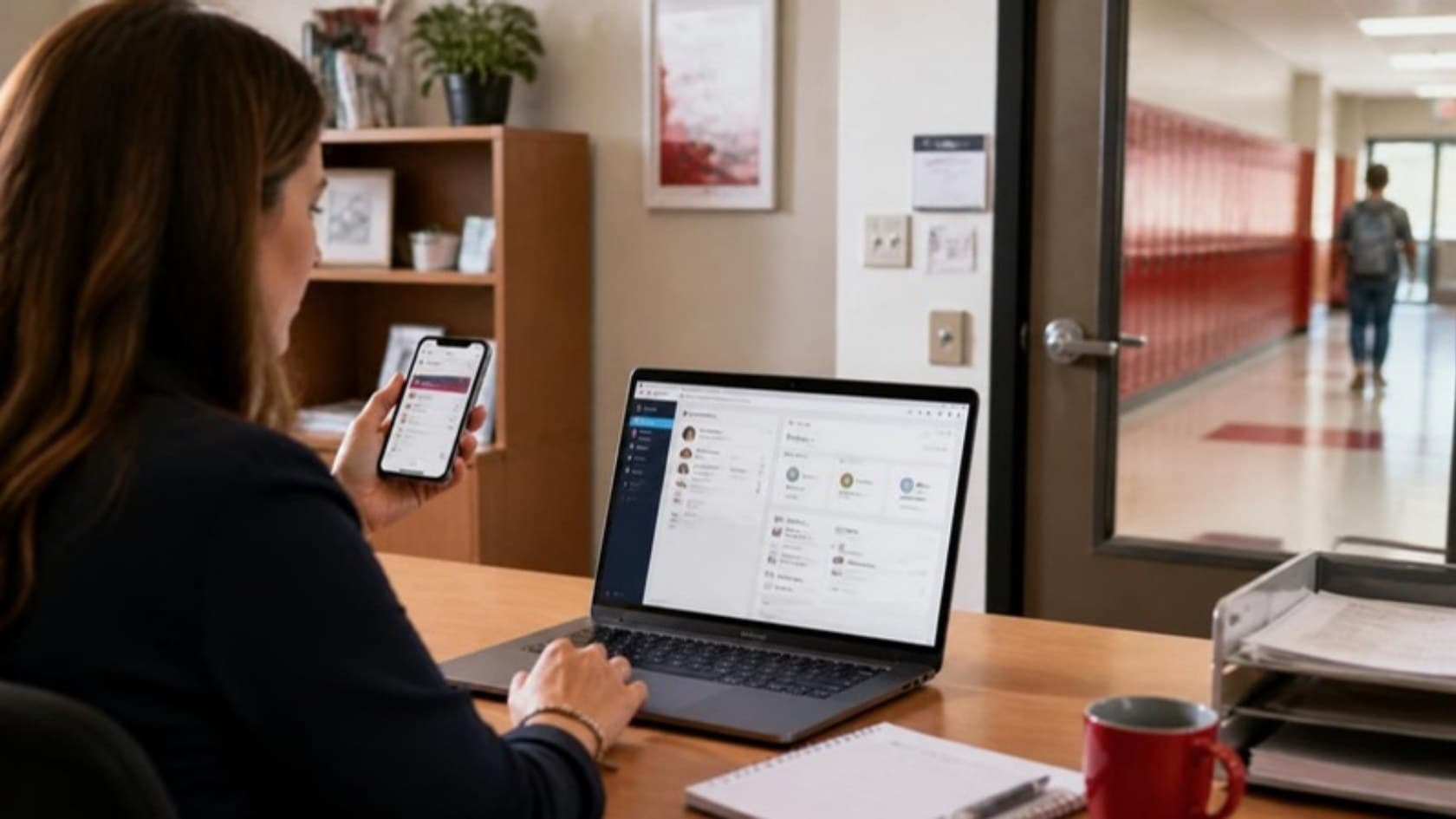
We built a school management ERP that runs in any web browser and as Android and iPhone apps. Staff use the same system on whatever they have to hand: a school computer, a personal laptop or the phone in their pocket.
Browser access: staff open the system from any modern web browser, with nothing to install.
Android and iPhone apps: the same school admin is available on the phones staff already carry.
One system behind all three: the web and both apps work on the same records. An update made on a phone is there when someone opens the browser.
What changed
Staff now manage school admin on devices they already carry, so the rollout needed no hardware spend. Admin work can be done when and where it comes up, instead of waiting for a particular computer.
What the research says
Much school admin could be automated. McKinsey research cited by the OECD, based on a survey of more than 2,000 teachers in four countries, estimates that 20% to 40% of teacher time goes on activities that could be automated. Moving admin into one system is the first step toward that.
Phones are already there. A 2025 Government of India survey found 85.5% of Indian households have at least one smartphone. Staff can run admin on a device they already own.
Most of those phones run Android. Statcounter measured Android on 93.89% of mobile web traffic in India in September 2026, with iOS at 6.05% (Statcounter Global Stats). Shipping both an Android and an iPhone app covers almost every phone a staff member might carry.
Computers often are not. Ministry of Education UDISE+ data for 2024-25 shows only 64.7% of Indian schools have a computer facility, so a system that needs a desktop leaves many schools out.
Choosing school software that people will use
Adoption decides whether a school management ERP pays off. A few checks help before you commit:
List every role that will use the system (office staff, teachers, leadership) and where each of them usually works.
Check which devices those people already have, and whether the system runs well on them.
Ask how one change, such as a fee update, reaches every screen, and how quickly.
Count the full cost, including any hardware, setup and support, not just the license.
Web and mobile access from one system usually answers most of these at once. Learn more about our ERP development and mobile app development work.
Other education projects are collected on our education software page, and our custom software development page explains how we scope a system like this.