

Most owners of mid-size firms have now heard the same two stories about AI. One says every competitor is already using it. The other says most AI projects fail. Both are partly true, and the published research shows where each one comes from.
This report pulls together the most recent government statistics and business surveys on how firms are using AI, what they are getting from it, and why so many trial projects never make it into daily work. It is written for owners and managing directors who run operations-heavy businesses and want a straight answer before spending money.
About this report
This report reviews published research from the US Census Bureau, the UK Office for National Statistics, Eurostat, the OECD, McKinsey, PwC, BCG, Gartner, S&P Global Market Intelligence and the MIT NANDA initiative, released between July 2024 and August 2026. It does not include iTechnoSol client data.
Each figure is linked to its source and carries the year it was published or collected. The surveys measure different things. Government surveys count all businesses, including very small ones. Consulting and analyst surveys mostly ask executives at larger companies. Where a finding comes from large companies only, we say so, and we explain what it likely means for a firm with 50 to 1,000 employees.
Finding 1: One firm in five uses AI, mid-size firms well above that
Government statistics give the most reliable picture of adoption because they survey businesses of every size. They show that AI use is growing fast but is still far from universal.
In the United States, the Census Bureau reported in May 2026 that overall AI use among businesses hovered between 17% and 20%, with 20% to 23% expecting to use it within six months. Size makes a large difference: 32% of firms with 100 to 249 employees and 37% of firms with 250 or more reported using AI, against under 20% of the smallest firms.
In the UK, the Office for National Statistics found in its July 2026 release that 35% of businesses with 10 or more employees used at least one AI technology in June 2026, up from about 12% in 2023. Among businesses with 250 or more employees the figure was 49%.
Across the European Union, Eurostat reported that 20.0% of enterprises with 10 or more employees used AI in 2025, up from 13.5% in 2024. Its detailed tables show 30.4% of medium-sized enterprises (50 to 249 employees) used AI in 2025, compared with 17.0% of small and 55.0% of large enterprises.
Source and year | Who was counted | All firms in scope | Mid-size or larger firms |
|---|---|---|---|
US Census Bureau, 2026 | US businesses | 17% to 20% | 32% (100 to 249 staff); 37% (250+) |
UK ONS, 2026 | UK businesses with 10+ staff | 35% | 49% (250+) |
Eurostat, 2025 | EU enterprises with 10+ staff | 20.0% | 30.4% (50 to 249); 55.0% (250+) |
OECD, 2025 | SMEs in seven countries | 31% use generative AI | Not reported by size band |
Use is also shallow. The ONS found that only 10% of UK businesses using AI described their use as extensive, and the average adopter used 1.6 AI technologies. The most common uses were text generation with large language models and visual content creation. In the EU, the most common use in 2025 was analyzing written language, reported by 11.8% of enterprises. In plain terms, many firms that count as AI users are using a chat tool to draft text, not running AI inside their order, finance or planning systems.
What this means for you
If your firm has 50 to 1,000 staff and is not yet using AI, you are not far behind. Roughly one mid-size firm in three in the US and the EU reports any use at all, and most of that use is light. The gap that matters is not whether staff have a chat tool. It is whether AI is doing real work inside the systems your business runs on.
Finding 2: Most firms using AI cannot yet see it in profit and loss
The consulting surveys ask larger companies a harder question: has AI changed the numbers? The answer, for most, is not yet.
McKinsey's August 2026 survey of 1,719 respondents found that 80% said AI had improved their own productivity, but only 37% attributed any EBIT impact to AI, about the same as a year earlier. Only around 6% qualified as high performers, meaning they attribute 5% or more of EBIT to AI and report significant value. The 2025 edition of the same survey found that 88% of organizations used AI in at least one business function, yet nearly two-thirds had not begun scaling it across the enterprise.
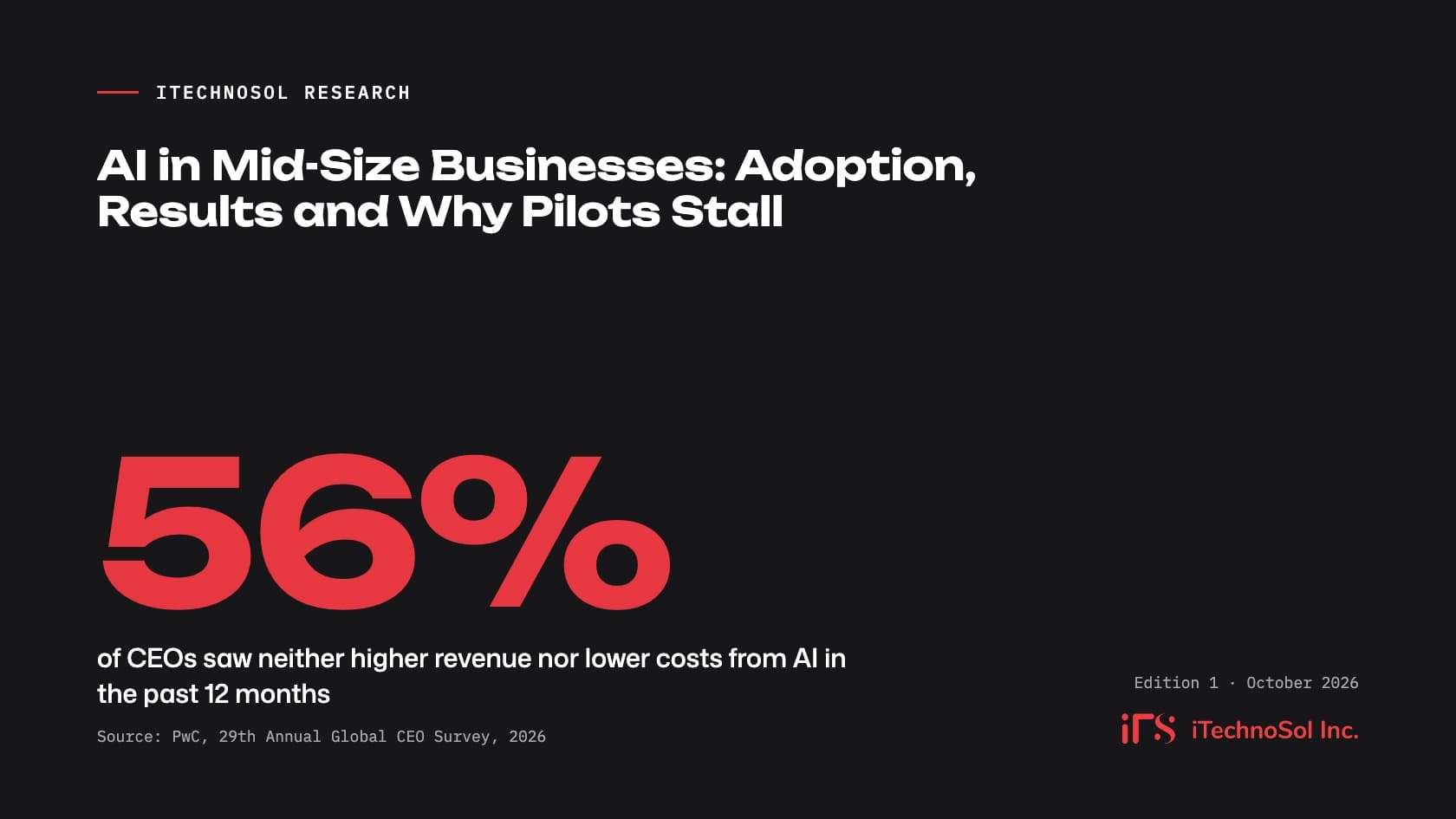
PwC's 2026 Global CEO Survey of 4,454 chief executives in 95 countries found that 56% had seen neither higher revenue nor lower costs from AI in the previous 12 months. The full survey report adds that 30% reported higher revenue from AI, 26% reported lower costs, and only 12% reported both.
BCG's September 2025 study of 1,250 executives reached a similar split. It found that 60% of companies reported little or no value from AI, while 5%, which BCG calls "future-built," were getting value at scale.
Source and year | Firms getting little or no measurable value | Firms getting clear value |
|---|---|---|
McKinsey, 2026 | 63% report no EBIT impact from AI | About 6% attribute 5%+ of EBIT to AI |
PwC CEO Survey, 2026 | 56% saw neither revenue nor cost gains | 12% saw both |
BCG, 2025 | 60% report little or no value | 5% get value at scale |
Smaller firms tell a slightly different story. In the OECD's survey of more than 5,000 SMEs in seven countries, 65% of SMEs using generative AI said it increased employee performance, while 26% said it helped increase revenue. The pattern is the same as in large firms. People feel faster, but the gain does not always reach the accounts.
What this means for you
Individual time savings are real, but they rarely show up as profit unless the saved time is put to use or the process itself changes. Before you start an AI project, decide which number on your monthly report it should move: days to close the books, order errors, stock write-offs, hours spent on a weekly report. If nobody can name the number, the project will probably join the majority that cannot show a return.
Finding 3: Pilots stall on cost, data and unclear value
The research on stalled projects is consistent about the causes. The software usually works in a demo. What breaks is everything around it.
In July 2024, Gartner predicted that at least 30% of generative AI projects would be abandoned after proof of concept by the end of 2025, citing poor data quality, inadequate risk controls, escalating costs or unclear business value. A year later it made a similar call about AI agents, predicting that over 40% of agentic AI projects will be canceled by the end of 2027 because of rising costs, unclear business value or inadequate risk controls. Gartner also warned that many vendors are relabeling existing products as "agents" without real agent capabilities.
S&P Global Market Intelligence's 2025 survey of enterprises in North America and Europe found that 42% of companies had abandoned most of their AI initiatives, up from 17% in 2024. On average, organizations scrapped 46% of their AI proofs of concept before they reached production.
The most quoted figure comes from MIT's NANDA initiative. Its July 2025 report, The GenAI Divide: State of AI in Business 2025, drew on interviews with 52 organizations, survey responses from 153 senior leaders and a review of more than 300 public AI initiatives. It found that "95% of organizations are getting zero return" from generative AI: just 5% of integrated AI pilots were extracting millions in value, while the rest showed no measurable impact on profit and loss. That number deserves care. The authors present it as preliminary findings, say their sample may not represent the wider market and note that organizations defined success differently. MIT NANDA also shares the report on request rather than publishing it openly. It measures whether a pilot could show a P&L effect, not whether the tool was useful. A project with no baseline measured beforehand will show nothing, even if it helped.
What this means for you
Read these failure rates as a warning about how projects are set up, not about AI itself. The reasons named again and again (data that is not ready, costs that grow after the demo, no agreed measure of value, no controls on risk) can all be checked before money is spent. A short, structured review of one department at the start is cheaper than a pilot that is quietly dropped six months later.
Finding 4: For smaller firms, the barrier is know-how and fit
Owners are not refusing AI. The surveys show they are unsure where it fits, worried about legal and data risks, and short of people who know how to set it up.
Among EU enterprises that considered AI in 2025 but did not use it, Eurostat found that 70.9% cited a lack of relevant expertise, 52.5% a lack of clarity about legal consequences, and 48.8% concerns about data protection and privacy. Only 20.7% said AI was not useful for their business.
The OECD's SME survey found a similar list. Among SMEs not using generative AI, 57% said it did not suit their work, 54% raised copyright, legal or regulatory concerns, 52% worried about what happens to data fed into AI models, and 50% cited a lack of employee skills. Yet 86% of SMEs held neutral or positive views of generative AI, and only 2% banned it. Among SMEs that do use it, a third or fewer were training staff, setting internal guidelines or checking legal issues.
In the UK, the ONS lists difficulty identifying business use cases among the most common barriers to adoption, alongside cost and a lack of expertise.
On jobs, the fear of sudden cuts is not borne out so far at smaller firms. The OECD found that 83% of SMEs said generative AI had no effect on overall staff need, and the ONS found that around half of UK businesses reported no change in headcount from AI.
What this means for you
The two questions to answer first are where AI fits in your work and what happens to your data. Both have practical answers. Your data can stay inside systems you control, contracts can spell out who owns what, and the people who will use the tool can be trained before it goes live. A firm that settles these points early removes most of the reasons the surveys list for not starting.
Finding 5: Firms that get value change the work, not just add a tool
When researchers compare the few companies getting real returns with everyone else, the difference is rarely the AI model. It is what the company changed around it.
McKinsey's March 2025 survey tested 25 practices and found that redesigning workflows had the biggest effect on whether a company saw EBIT impact from generative AI. Yet only 21% of respondents said their organizations had fundamentally redesigned at least some workflows. The same survey found that only 27% of organizations using generative AI had employees review all AI-generated content before use. McKinsey's 2025 State of AI report adds that high performers are more likely to define when model outputs need human validation.
BCG found that 70% of the potential value from AI sits in core business functions such as sales, manufacturing and R&D, not in support functions. Its future-built companies reported twice the revenue growth and 40% more cost savings than companies lagging behind.
What this means for you
Putting a chatbot next to an old process tends to produce a slightly faster old process. The returns come from asking how the work should run now that part of it can be done by software: who checks what, which steps disappear, and where a person still makes the call. For an operations-heavy firm, that usually means the core flows (orders, invoices, stock, scheduling) rather than a side project in marketing.
How mid-size firms get value from AI
The research points to a short list of habits that separate projects that pay off from projects that stall. None of them require a large AI team.
1. Scope one process with one number
Start with a single process that hurts, such as month-end close, purchase order matching or demand planning. Write down how it works today, how long it takes and what it costs. Pick the one number the project should move. This is the baseline that most failed pilots never had, and it is what lets you show a return later.
2. Check the data before building anything
Poor data quality is the first reason Gartner gives for abandoned projects. Find out where the data for that process lives, how clean it is and who owns it. In many mid-size firms the honest answer is that the data sits across an old ERP, spreadsheets and email. Fixing that is often the first piece of work, and it pays off even before AI is added. This is why we put software first and AI on top of it.
3. Design where a person approves
Decide in advance which outputs a person must check before they go anywhere: a payment, a customer reply, a change to a forecast. Start with more human approval than you think you need and relax it as accuracy is proven. This answers the risk-control concerns that Gartner, Eurostat and the OECD all report, and it gives your team a reason to trust the system instead of working around it. Our page on AI agents and automation shows how approval steps fit into an agent's work.
4. Redesign the workflow, not just the task
Once AI handles a step, other steps may no longer be needed. Map the new flow end to end. Much of the value in a typical project comes from plain workflow automation (routing, approvals, data moving between systems) with AI handling the parts that need judgment, such as reading a document or classifying a request.
5. Measure monthly, and budget for running costs
Track the chosen number every month against the baseline. Budget for running costs as well as the build. In McKinsey's 2026 survey, about 20% of respondents said AI operating costs had constrained their use. For forecasting work, such as predictive analytics for demand or cash flow, compare the model's forecast with what actually happened, and keep the old method running alongside until the new one has earned trust.
6. Decide what to buy and what to build
Off-the-shelf tools suit common tasks. Work that touches your own systems and data often needs something built for it. The same McKinsey survey found that nearly a third of respondents (32%) said their organizations had decided against buying a software product because it could be built internally with agentic coding tools. Whichever route you choose, make sure you own the code and the data, and that the system can be maintained after the first project ends.
Where to start
The research does not say AI fails. It says AI fails when it is bolted on without a baseline, clean data, human checks and a plan to change the work. Those are management decisions, and mid-size firms can make them faster than large ones. If you want to know where AI would pay off in your business, our free 5-day AI readiness audit looks at one department and tells you plainly what is worth doing and what is not. If you would rather talk it through first, you can book a 30-minute call with a founder.
Sources
Large Firms With at Least 20 Employees Biggest AI Users. US Census Bureau, 2026.
Artificial intelligence in UK businesses: 2023 to 2026. Office for National Statistics (UK), 2026.
20% of EU enterprises use AI technologies. Eurostat, 2025.
Use of artificial intelligence in enterprises (Statistics Explained). Eurostat, 2025.
Generative AI and the SME Workforce: New Survey Evidence. OECD, 2025.
The state of AI in 2026: On the road to ROI. McKinsey & Company, 2026.
The state of AI in 2025: Agents, innovation, and transformation. McKinsey & Company, 2025.
The state of AI: How organizations are rewiring to capture value. McKinsey & Company, 2025.
PwC 2026 Global CEO Survey (press release). PwC, 2026.
29th Annual Global CEO Survey (full report). PwC, 2026.
AI Leaders Outpace Laggards with Double the Revenue Growth and 40% More Cost Savings (The Widening AI Value Gap). Boston Consulting Group, 2025.
The GenAI Divide: State of AI in Business 2025 (preliminary findings; report shared on request by MIT NANDA). MIT NANDA (A. Challapally, C. Pease, R. Raskar, P. Chari), 2025.
Gartner Predicts 30% of Generative AI Projects Will Be Abandoned After Proof of Concept By End of 2025. Gartner, 2024.
Gartner Predicts Over 40% of Agentic AI Projects Will Be Canceled by End of 2027. Gartner, 2025.
AI experiences rapid adoption, but with mixed outcomes: Highlights from VotE: AI & Machine Learning. S&P Global Market Intelligence, 2025.