
About this report
Most companies that try AI blame the model when results disappoint. Surveys of data leaders point somewhere less glamorous: the data the model is fed. This report reviews what the 2024 to 2026 research says about data readiness, meaning whether a company's data is accurate, complete, accessible and well governed enough for an AI system to use. It draws on one academic-industry study, one IBM survey of 1,700 data leaders, two vendor surveys, two government statistics releases, a Gartner analyst Q&A and a RAND interview study. It says where each source is weak. It is a review of other people's research, not a study of our own. Figures are quoted as the sources give them, and every figure was checked against the publisher's own page on 25 October 2026.
The short answer
What is data readiness? Data readiness is the state of your business data being good enough, and reachable enough, for a specific AI use. It has four parts: the data is accurate, it is complete, people and systems can get to it, and someone owns it. Gartner, in an analyst Q&A published on 26 February 2025, says AI-ready data is not "one and done" but a practice that needs constant improvement, and that leaders must define what counts as AI-ready for each specific use.
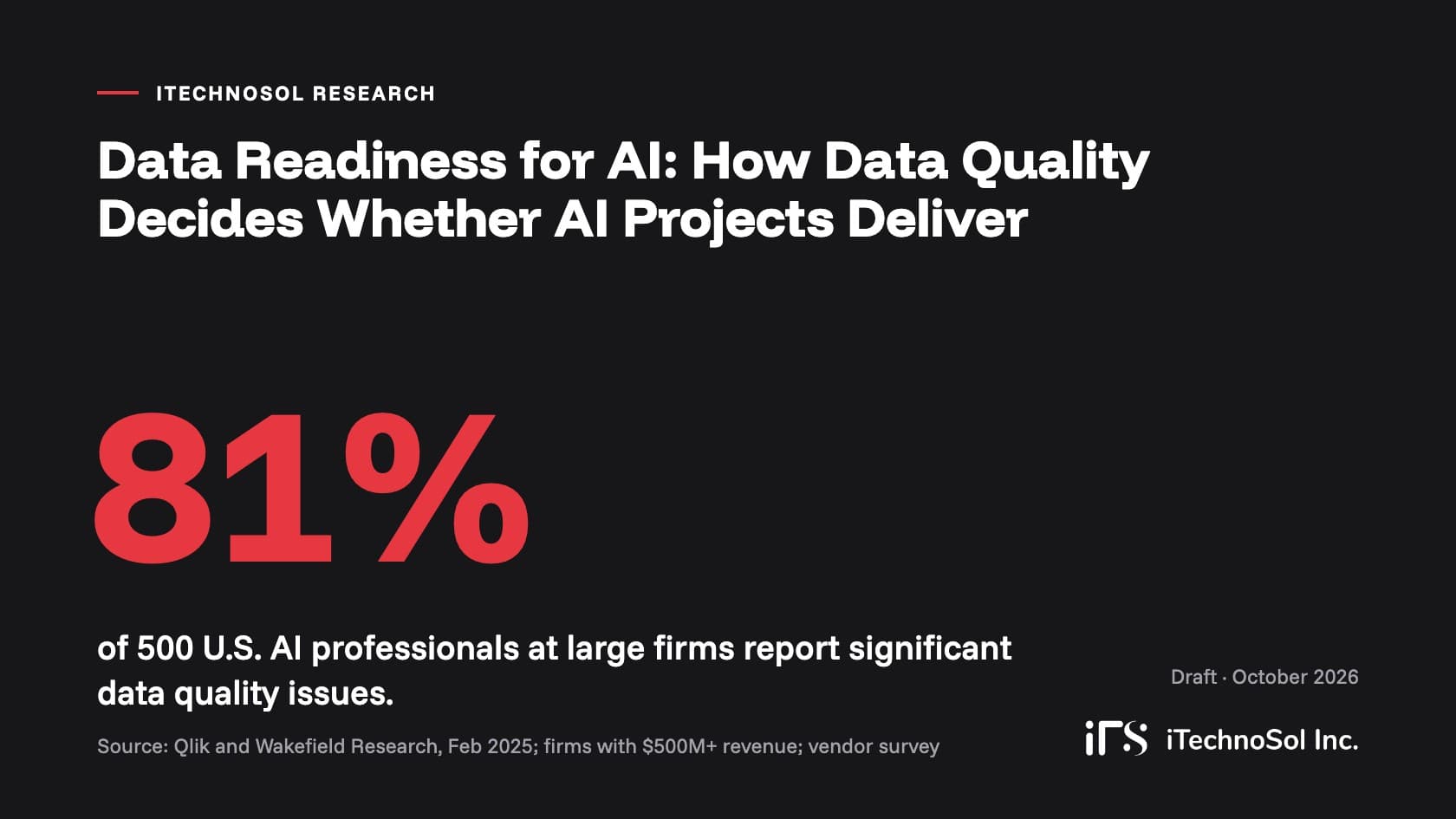
How often do AI projects fail for data reasons? No source we could verify gives one clean number. What the evidence does show is that data problems are common and are named as a top obstacle. Informatica's 2025 survey of 600 chief data officers put data at 43% of the top obstacles to moving generative AI pilots into production. Qlik's 2025 survey found 81% of AI professionals at large U.S. companies reporting significant data quality problems. Both are vendor surveys. Gartner forecasts that through 2026 companies will abandon 60% of AI projects that lack AI-ready data, which is a forecast, not a measured failure rate.
What should you fix first? Fix the data behind one use case, not all company data. Name the question the AI must answer, list the records it needs, then check who owns them, how complete and current they are, and whether the system can legally and technically reach them. That ordering is our judgment, informed by the findings below, not a conclusion any one study tested.
Finding 1: Gartner forecasts that 60% of AI projects without AI-ready data will be abandoned
A Gartner Q&A with analyst Roxane Edjlali, published on 26 February 2025, says 63% of organizations either do not have or are unsure whether they have the right data management practices for AI. It bases this on a Gartner survey of 1,203 data management leaders conducted in July 2024. Gartner also predicts that through 2026, organizations will abandon 60% of AI projects unsupported by AI-ready data. This is an analyst prediction, so treat it as a warning about direction and not as a count of failed projects. (Other writers cite a smaller Gartner sample of 248; Gartner's own page gives 1,203, so we use that.)
Finding 2: Data leaders say AI plans are ahead of their data
The IBM Institute for Business Value polled 1,700 senior leaders in data and analytics, chief data officers among them, across 19 industries and 27 geographies from July to September 2025, with Oxford Economics as research partner (IBM, 13 November 2025). Only 26% were confident their data could support new AI-enabled revenue streams, and only 26% were confident their organization could use unstructured data, such as documents and emails, to deliver business value. The study lists accessibility, completeness, integrity, accuracy and consistency as barriers to using enterprise data for AI. It is a self-assessment by data leaders, and IBM sells data and AI products.
Finding 3: Data is a top reason pilots do not reach production
Informatica's CDO Insights 2025 asked 600 executives in the U.S., Europe and Asia holding chief data officer or chief data and analytics officer titles about generative AI. Among those using or planning it, the leading obstacles to moving pilots to production were data and technology (43% each), then people and process (35% each) and regulations (34%). Separately, 38% named lack of trust in data quality as a difficulty in demonstrating business value, and 92% were concerned that pilots are moving forward without addressing earlier challenges. Informatica sells data management software. Its category "data" is broader than data quality, so the 43% should not be read as a data quality rate.
Finding 4: Four in five AI professionals report significant data quality problems
Qlik's AI survey, fielded by Wakefield Research from 4 to 18 February 2025, asked 500 U.S. data and analytics professionals working with AI at companies with at least $500 million in annual revenue. Eighty-one percent said significant data quality issues persist at their company, and 85% believed leadership is not addressing them. The respondents are large-company insiders, not a random sample of businesses, and Qlik is a data integration vendor. The headline of Qlik's release also cites a 96% figure that we could not trace to its body text, so we do not use it.
Finding 5: A widely cited failure study blames missing learning and fit, and does not single out data
MIT's NANDA project reported in July 2025 that 95% of organizations in its research were getting zero return from generative AI, with just 5% of integrated pilots extracting millions in value. The evidence base is a review of over 300 public AI initiatives, 52 interviews and 153 survey responses from senior leaders, collected January to June 2025. On enterprise-grade tools, 60% of organizations evaluated them, 20% reached pilot and 5% reached production. The authors say the core barrier is not infrastructure, regulation or talent but learning: most systems cannot hold on to feedback, adjust to their context or get better with use. Data readiness is therefore not the headline cause in this study. In our reading, a system that cannot get at the right context is partly a data problem, but the study does not say that. The authors label the work preliminary, and its survey part is 153 leaders collected at four industry conferences, so it is not a random sample.
Finding 6: Firms that held off on AI cite skills and legal doubt before data
Eurostat's 2025 release (from a 2025 survey of enterprises with 10 or more employees, 157,000 of 1.53 million EU enterprises) found 19.95% used at least one AI technology: 17% of small, 30.36% of medium and 55.03% of large enterprises. Among the 14.21% of non-users that had considered AI, the reasons were lack of relevant expertise (70.89%), unclear legal consequences (52.52%) and data protection and privacy concerns (48.83%). Eurostat does not report data quality as a separate reason. In the United States, the Census Bureau's Business Trends and Outlook Survey found 19.8% of businesses used AI as of 3 May 2026, and 37% of firms with 250 or more employees. Its release did not report results on barriers. Our reading, not the statisticians': for a mid-size company, data may be a hidden problem, because it does not appear among the barriers these adoption surveys report.
What the evidence does not show
No source we verified measures the share of AI projects that fail specifically because of data. Gartner's 60% is a forecast about projects without AI-ready data, and the surveys report opinions and obstacles.
Three of the surveys come from vendors that sell data tools (Informatica, Qlik, IBM). Their questions and category names may favor data as an explanation.
The MIT study is preliminary and does not separate data from other causes. RAND's August 2024 report on AI project failure, based on interviews with 65 experienced data scientists and engineers, names five root causes; the second is that the organization lacks the data needed to train an effective model, and the fourth is inadequate infrastructure to manage data. It is a qualitative interview study, not a failure rate. RAND notes that the "more than 80 percent of AI projects fail" figure is only "by some estimates"; we do not use it.
Nothing here tests whether cleaning data first raises a project's success rate. That is a plausible reading, not a proven one.
Most data is from large companies. Surveys of mid-size businesses are scarce, and the Eurostat and Census releases cover adoption, not outcomes.
What this means for an owner or CFO
Treat data as a cost line in the AI business case, not an assumption. This section is our view, not a finding of the studies above. In our view, companies often buy tools first and discover their data problems during the pilot, when changing course is expensive. Ask three questions before approving a budget: which specific records will the AI use, who is accountable for their accuracy, and what would we do if 20% of them are wrong or missing? If nobody can answer, the first spend should be on the data, not the model. Our guide Data readiness for AI walks through the checks, and 10 questions before you invest covers the wider decision.
Where to start
Pick one use case and trace its data from source to answer. The research does not rank the fixes, so this order is our judgment, built from the obstacles the surveys name:
Accuracy and completeness. Sample 100 records the AI would use and count the ones that are wrong, duplicated or blank. IBM and Qlik respondents both report these problems.
Access. Confirm the system can reach the data, in the right format, without copying it into places that break your privacy rules. IBM lists accessibility as a barrier, and Eurostat shows privacy concerns weigh on firms that considered AI and did not adopt it.
Ownership. Name one person accountable for each data source. Qlik found 85% of respondents believe leadership is not addressing quality, which may mean nobody owns it.
Measurement. Write down today's cost, time or error rate for the task before the pilot starts. IBM found only 29% of data leaders have clear measures of the value of data-driven outcomes, and without a baseline you cannot show a return.
Our free AI readiness audit scores your starting position, and you can book a call if you want a second opinion on your plan.
Sources
Gartner (2025). Lack of AI-Ready Data Puts AI Projects at Risk, Q&A with Roxane Edjlali, 26 February 2025.
IBM Institute for Business Value (2025). IBM Study: Chief Data Officers Redefine Strategies as AI Ambitions Outpace Readiness, 13 November 2025.
Informatica (2025). CDO Insights 2025: Global data leaders racing ahead despite headwinds to being AI-ready.
Qlik (2025). Data quality is not being prioritized on AI projects (Qlik AI Survey, Wakefield Research).
Challapally, A., Pease, C., Raskar, R. and Chari, P. (2025). The GenAI Divide: State of AI in Business 2025. MIT NANDA, July 2025 (copy hosted by Webber Wentzel).
Eurostat (2025). Use of artificial intelligence in enterprises.
U.S. Census Bureau (2026). Large Firms With at Least 20 Employees Biggest AI Users, 26 May 2026.
Ryseff, J., De Bruhl, B. F. and Newberry, S. J. (2024). The Root Causes of Failure for Artificial Intelligence Projects and How They Can Succeed. RAND, RR-A2680-1, 13 August 2024.