

Most finance teams in mid-size firms still run on a familiar loop. Invoices arrive by email, someone keys them in, a manager approves them when they get a minute, and at month-end the team stays late matching bank lines to ledger entries. Meanwhile the owner asks a simple question, "How much cash will we have in eight weeks?", and gets a spreadsheet built on last month's guesses.
Automation can change that loop, but not every finance process pays back at the same speed. Some have high volume, clear rules and clean data. Others carry real risk if a machine gets them wrong. This report pulls together the published research on accounts payable, payment fraud, month-end close and cash forecasting to answer one practical question: where do the returns show up first?
About this report
This is a research review. iTechnoSol did not run its own survey for it, and none of the figures below come from our clients or projects. Every number is taken from a published study by an analyst firm, professional body, consultancy or government source, and each one is linked where it appears, with the year it was published. Where a benchmark is older, or a study was sponsored by a software vendor, we say so.
Most of these surveys lean toward large companies, often above $1 billion in revenue, and toward North America. A mid-size firm in Manchester, Rotterdam or Dubai should read them as direction, not as a precise forecast for its own books. The ranking table and the advice near the end are our own judgment, built from that research, and are labeled as such.
Finding 1: Top AP teams now lead the rest by about five to one
Accounts payable is the most heavily measured process in finance, which makes it the easiest place to see what automation is worth. Ardent Partners' State of ePayables 2025, a sponsored report distributed by payments software vendor Bottomline and based on 204 AP and finance leaders surveyed between March and May 2025, puts the average all-in cost of processing one invoice at $9.84, and the average time to process it at 8.2 days.
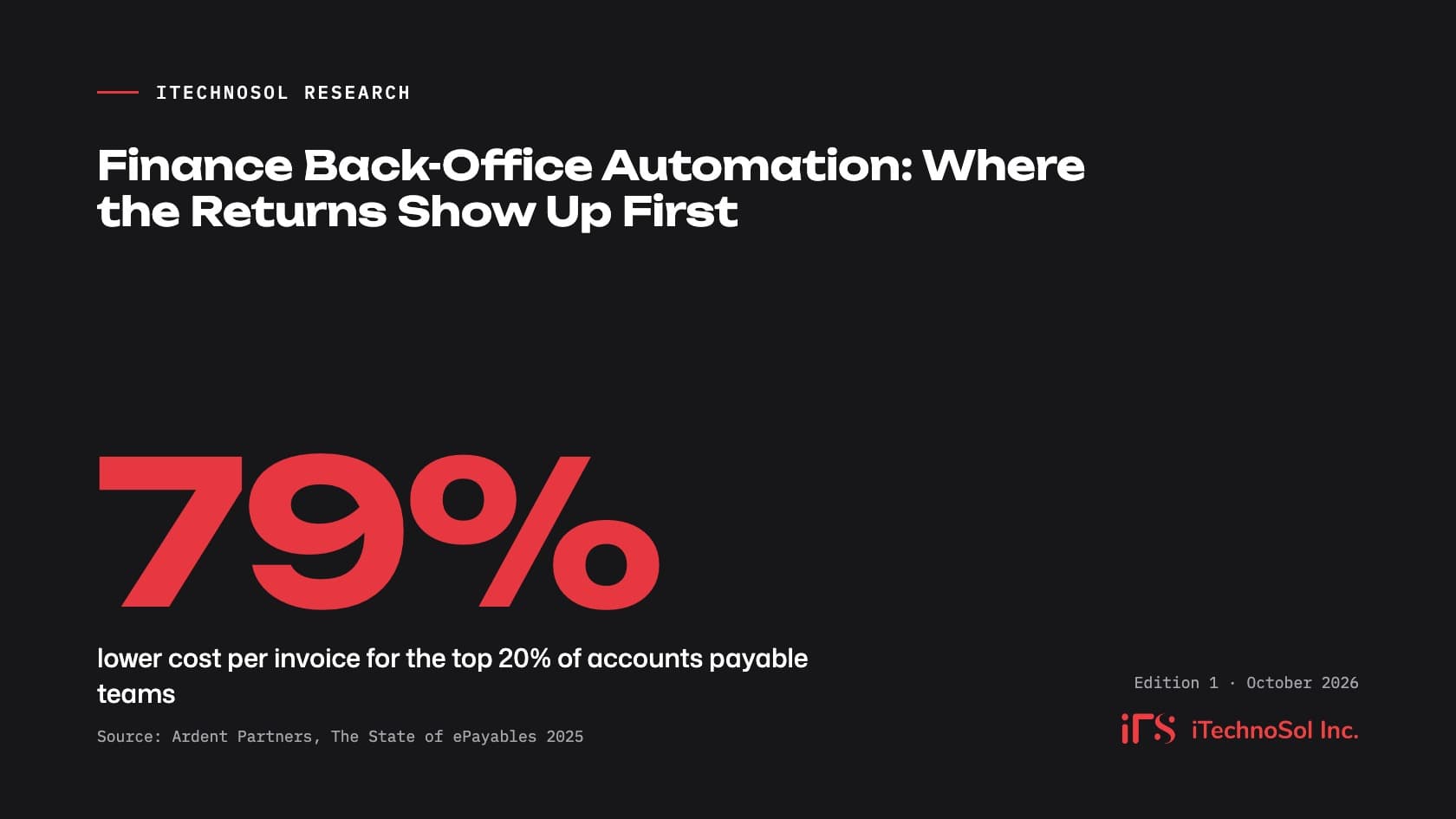
Ardent separates out the top 20% of organizations, ranked by lowest cost and shortest cycle time. That group spends $2.65 per invoice and takes 2.9 days. Everyone else spends $12.42 and takes 13.5 days. In Ardent's words, the top group's per-invoice costs are 79% lower and its processing times 79% faster.
The pattern is not new. APQC's benchmarking data, published in a February 2018 CFO.com column by APQC's own CFO, showed that among 1,485 organizations the top quartile spent $2.07 or less per invoice, the median $5.83 and the bottom quartile $10 or more. APQC's current open benchmark, drawn from 5,846 organizations, puts the median at $6.00 per invoice; its quartile figures are available only to members. APQC measures cost differently from Ardent, so the two should not be compared line by line. What both sources agree on is the shape: a small group processes invoices for a fraction of what the rest pay.
The top performers are not doing anything exotic. In the Ardent data, 67.2% of their suppliers send invoices electronically, against 47.3% for everyone else, and 84.0% of their invoices are linked to a purchase order, against 47.3%. Clean, structured invoices that match a purchase order are what let software do the work.
What this means for you
If your firm handles a few thousand supplier invoices a month, AP is likely the fastest place to see a measurable return. Before buying anything, work out your own cost per invoice (staff time plus systems, divided by invoice count) and your average days from receipt to approval. Those two numbers tell you how far you are from the benchmarks above and what closing the gap is worth.
Finding 2: Exceptions and slow approvals are the real drag
Many owners picture AP automation as "reading invoices so nobody has to type them." That helps, but the research points to a different bottleneck. When Ardent Partners asked AP leaders about their top challenges in 2025, 49% said approvals take too long and 48% named a high percentage of exceptions. Fraud risk came third at 31%.
An exception is any invoice that cannot go straight through: the price does not match the purchase order, the quantity is off, the supplier is not set up, or nobody knows who should approve it. The average exception rate in the 2025 Ardent benchmarks is 18.4%, and only 35.4% of invoices are processed "straight-through" without anyone touching them. The top group runs an 11.1% exception rate and pushes 51.0% of invoices straight through.
Exceptions also generate phone calls. Staff in the average AP team spend 21.9% of their time handling supplier inquiries, according to the same report. In the top group that falls to 12.8%; for everyone else it is 24.0%. That is roughly one day a week per person spent answering "where is my payment?"
What this means for you
Data capture is the entry ticket, not the prize. The bigger saving comes from routing approvals automatically to the right person, chasing them when they stall, and sorting exceptions by cause so the same mismatch is fixed once at the source. A supplier portal that shows payment status can cut inquiry calls without adding staff.
Finding 3: Payment fraud is common, so controls are part of the return
Any project that speeds up payments has to be weighed against fraud. The 2026 AFP Payments Fraud and Control Survey, released in April 2026 from 465 treasury practitioners surveyed in January 2026, found that 76% of US organizations experienced attempted or actual payments fraud in 2025. About three in four (74%) were affected by business email compromise, the scam where a fraudster poses as a supplier or executive to redirect a payment.
The losses are large. The FBI's 2025 IC3 Annual Report, released in April 2026, recorded 24,768 business email compromise complaints with reported losses of $3.05 billion in 2025, up from $2.77 billion in 2024. Business email compromise was the second-costliest crime type after investment fraud. The same report notes businesses lost more than $30 million in 2025 to business email compromise scams involving AI, such as cloned voices or convincing fake emails from an executive.
Few firms are using technology to fight back. Only 17% of organizations use AI to combat payments fraud, according to the AFP survey. Among organizations with revenue under $1 billion, 48% incurred actual losses.
What this means for you
Faster payments without stronger controls just means faster losses. A well-built AP workflow can make fraud harder: it can flag a changed bank account, hold a payment to a new supplier, and stop an invoice that does not match a purchase order. Build those checks in from day one and count them as part of the return, not as overhead.
Finding 4: Month-end close times vary widely between teams
The close is where finance work piles up: reconciling bank accounts, posting accruals, chasing missing invoices and building the reports the board reads. APQC's open benchmark for the monthly close, drawn from 11,223 organizations, puts the median at 6.0 calendar days from running the trial balance to completing the consolidated statements. APQC shares the spread around that median only with members. The latest public quartile figures come from a March 2018 CFO.com column by APQC's CFO, based on about 2,300 organizations: the top quartile needed 4.8 days or less, the median 6.4 days and the bottom quartile 10 days or more. Those quartiles date from 2018, but the gap they show is the point.
Finance leaders are already pointing AI at the close's raw material. In Gartner's 2025 survey of 183 CFOs and senior finance leaders, 59% said they use AI in the finance function, almost unchanged from 58% a year earlier. The most common uses were knowledge management (49%), accounts payable process automation (37%) and error and anomaly detection (34%).
Gartner also predicted in February 2026 that finance teams using cloud ERP applications with embedded AI assistants could see a 30% faster financial close by 2028. That is a forecast, not a measured result, and it assumes a modern ERP.
Larger companies are planning to push further. In Deloitte's Q4 2025 CFO Signals survey of 200 North American CFOs at companies with $1 billion or more in revenue, 87% said AI will be extremely or very important to finance operations in 2026. Asked about talent, 49% named automating processes to free staff for higher-value work as their top priority.
What this means for you
You do not need a new ERP to shorten the close. Bank and intercompany reconciliations are rule-based and repeat every month, so they are the usual first step. Matching software clears the easy lines and leaves the true mismatches for a person. Recurring journal entries and an automated close checklist come next. The judgment calls, such as accrual estimates and provisions, stay with your accountants.
Finding 5: Cash forecasting is still manual, mostly due to bad data
For an operations-heavy firm, cash visibility is often worth more than any saving in AP. Yet forecasting remains stubbornly manual. PwC's 2025 Global Treasury Survey of 350 treasurers found that 52% of firms with $1 billion to $10 billion in revenue manually collect and consolidate their forecasting data. Poor data quality, cited by 76%, was the main obstacle to better forecasting. Teams using manual methods rated their satisfaction at 2.9 out of 5, against 3.3 for teams using system-based forecasting.
Pressure from the top is rising. Strategic Treasurer's 2025 Cash Forecasting and Visibility Survey, sponsored by treasury software vendor TIS, is shared only on request. Its headline figures were published by CTMfile, a news site owned by Strategic Treasurer: 68% of companies reported higher management expectations for cash forecasting, and asked which aspects were under more scrutiny, 76% named accuracy. Only 14% now describe forecasting as easy, down from 28% in 2018, and 53% call it difficult. The same CTMfile article reports that in a separate Strategic Treasurer study, the 2025 AI in Treasury & Finance Survey, the share of practitioners expecting AI to improve cash forecasting rose from 65% in 2024 to 76% in 2025.
What this means for you
A forecasting model is only as good as what feeds it. The first win is usually plumbing, not prediction: pull bank balances, open payables, open receivables and the order book into one place automatically every day. Once that data is reliable, a statistical or machine-learning forecast has something to work with. Starting with the model and skipping the data step is the most common way these projects disappoint.
Finding 6: E-invoicing mandates will soon force changes in AP
For firms trading in Europe, the UK or the Gulf, automation is moving from optional to required. The EU's VAT in the Digital Age package was adopted by the Council in March 2025. Under the resulting Council Directive (EU) 2025/516, member states have been able to require domestic e-invoicing since the directive came into force in April 2025, and from July 1, 2030 structured e-invoicing becomes mandatory for cross-border business-to-business supplies within the EU.
In the UAE, Ministerial Decisions No. 243 and 244 of 2025 set the rollout. According to the Ministry of Finance's Electronic Invoicing Guidelines (June 2026), an invitation-only pilot began on July 1, 2026. Businesses with revenue of AED 50 million or more must implement e-invoicing by January 1, 2027, smaller businesses by July 1, 2027, and government entities by October 1, 2027.
In the UK, the government's consultation response, updated in November 2025, confirmed that all VAT invoices for business-to-business and business-to-government transactions must be issued as e-invoices from 2029, with an implementation roadmap due at Budget 2026.
What this means for you
Structured e-invoices remove the capture step entirely, which is good news for AP costs. But your systems must be able to send, receive and post them. If you are planning AP automation anyway, design it around the e-invoicing format your markets will require, so you build once instead of twice.
Which finance processes suit automation first
The table below is our own assessment, drawn from the research above and from how these processes usually work in mid-size firms. It is not a survey result. Each process is rated on four things: how many transactions it handles, how rule-based the work is, how clean the input data tends to be, and how much harm an error could do.
Process | Volume | Clear rules | Typical data quality | Risk if wrong | Fit for automation |
|---|---|---|---|---|---|
Invoice capture and purchase-order matching | High | High | Medium (better with e-invoices) | Low to medium | Start here |
Bank and card reconciliations | High | High | High (bank data is structured) | Low | Start here |
Approval routing and reminders | High | High | High | Low | Start here |
Expense report checks | Medium to high | High (policy limits) | Medium (receipts vary) | Low | Early |
Recurring journals and close checklist | Medium | High | Medium | Medium | Early |
Cash forecasting | Low (one forecast, many inputs) | Medium | Often low | Medium | After the data is fixed |
Accruals, provisions and judgment entries | Low | Low | Mixed | High | Assist only |
Payment release and supplier bank detail changes | Medium | Medium | Medium | Very high | Prepare automatically, a person approves |
The pattern is simple. Start where volume and rules are both high and the cost of a mistake is low. Keep people in charge wherever money leaves the building or judgment shapes the numbers.
Where to start, what to keep, what to measure
Where to start
Pick one process, not the whole department. Supplier invoices or bank reconciliations are usually the cleanest first project because the volume is high and the rules are written down.
Measure before you build. Record today's cost per invoice, days to approve, exception rate and days to close. Without a baseline, nobody can say later whether the project paid off.
Fix the inputs. Ask your largest suppliers to send electronic invoices and quote purchase-order numbers. The Ardent data shows these two habits separate the top group from the rest.
Work with the systems you have. Most gains come from connecting your existing accounting system, bank feeds and email inbox, not from replacing them.
Controls to keep
A person approves every payment run. Software can prepare the batch, check it against approved invoices and flag anything unusual. A named person releases the money.
Verify every bank detail change by phone. Call the supplier on a number already on file, never one given in the email asking for the change. Business email compromise, which the FBI links to $3.05 billion in reported 2025 losses, depends on that change going through unchecked.
Separate duties. The person who sets up or edits a supplier should not be the person who approves its payments.
Keep an audit trail. Every automated step should log what it did and why, so your auditors can follow any invoice from receipt to payment.
Hold new and changed suppliers. Put first payments to a new supplier, or the first payment after a bank change, through an extra review.
What to measure
Cost per invoice processed, all-in.
Days from invoice receipt to approval, and to payment.
Share of invoices processed straight-through with no manual touch.
Exception rate, broken down by cause.
Calendar days to close the month.
Forecast accuracy: actual cash against forecast at four and thirteen weeks.
Fraud attempts caught by controls, and payments held for review.
Review these monthly for the first six months. If a number is not moving, the problem is usually an upstream input, such as suppliers still sending PDFs or approvers ignoring reminders, rather than the software.
Next step
The research points to a clear order: invoices, approvals and reconciliations first, then the close, then forecasting once the data is clean, with human approval kept on every payment. Where your own firm sits depends on your volumes, your systems and how clean your data is today.
If you want to see how this would work in your business, our workflow automation and RPA services pages explain how we connect to the accounting and banking systems you already use. Or start smaller: the free AI readiness audit looks at one department for five days and tells you where automation would pay back first, before you commit to anything.
Sources
The State of ePayables 2025: AP's Unfinished Journey (sponsored report, distributed by Bottomline). Ardent Partners, 2025.
Metric of the Month: Accounts Payable Cost (APQC benchmarking data, column by APQC CFO Perry D. Wiggins). CFO.com / APQC, 2018.
Total cost to perform the process "process accounts payable (AP)" per invoice processed (Open Standards Benchmarking, measure 100451). APQC, Accessed October 2026.
Metric of the Month: Cycle Time for Monthly Close (APQC benchmarking data, column by APQC CFO Perry D. Wiggins). CFO.com / APQC, 2018.
Cycle time in days to complete the monthly consolidated financial statements (Open Standards Benchmarking, measure 100162). APQC, Accessed October 2026.
Over 75% of US Firms Experienced Payments Fraud in 2025, While AI Adoption for Fraud Mitigation Lags (2026 AFP Payments Fraud and Control Survey). Association for Financial Professionals, 2026.
2025 IC3 Annual Report. FBI Internet Crime Complaint Center, 2026.
Gartner Survey Shows Finance AI Adoption Remains Steady in 2025. Gartner, 2025.
Gartner Predicts Embedded AI in Cloud ERP Applications Will Drive a 30% Faster Financial Close by 2028. Gartner, 2026.
Deloitte Q4 2025 CFO Signals Survey. Deloitte, 2026.
2025 Global Treasury Survey. PwC, 2025.
Treasury cash forecasting: Rising expectations, growing complexity, AI's promise (summary of Strategic Treasurer survey results). CTMfile (owned by Strategic Treasurer), 2025.
2025 Cash Forecasting & Visibility Survey (full report on request; sponsored by TIS). Strategic Treasurer, 2025.
2025 AI in Treasury & Finance Survey (full report on request). Strategic Treasurer, 2025.
Taxation: Council adopts VAT in the digital age package. Council of the European Union, 2025.
Council Directive (EU) 2025/516 of 11 March 2025 amending Directive 2006/112/EC as regards VAT rules for the digital age. Official Journal of the European Union (EUR-Lex), 2025.
UAE Electronic Invoicing Guidelines, Version 1.1. UAE Ministry of Finance, 2026.
Promoting electronic invoicing across UK businesses and the public sector: consultation response. HM Revenue & Customs and HM Treasury (GOV.UK), 2025.